SmartBlink

Image Review

v0.5

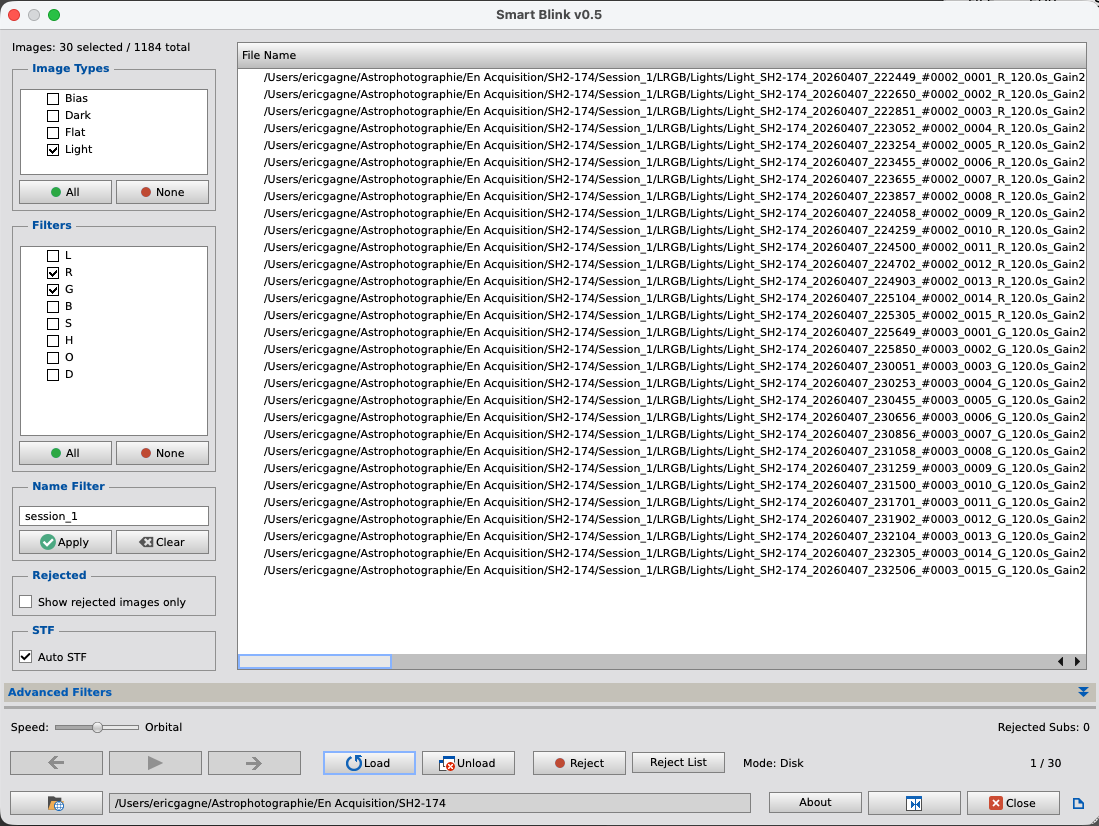
PixInsight's built-in Blink tool is simple by design — you point it at a folder and it cycles through images. SmartBlink starts where Blink stops.

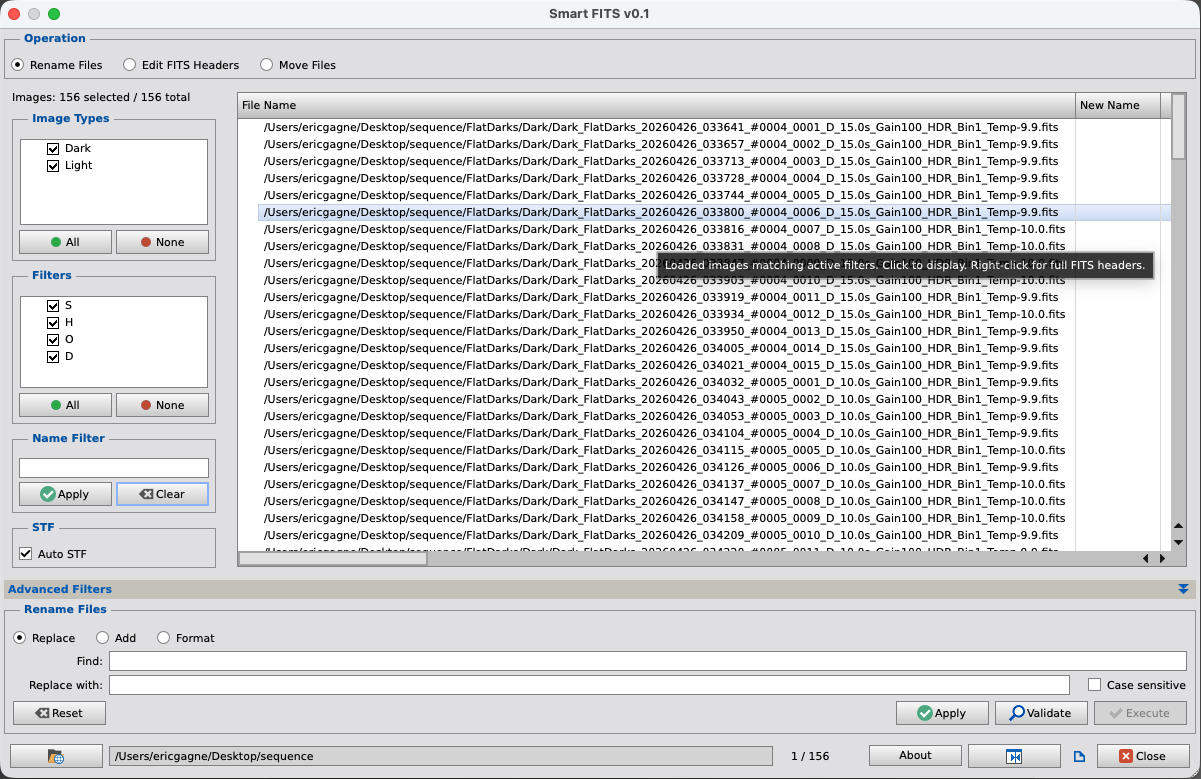
Point SmartBlink at your root acquisition folder and it recursively scans all subfolders, finding every FITS and XISF file in your session. It then reads the FITS headers of each file to extract image type (Light, Flat, Dark, Bias), filter name, and every other keyword present — giving you a fully indexed library of your frames before you review a single image.

From there, dynamic filters let you narrow the view to exactly what you want to inspect: only your Ha lights, only a specific exposure time, only frames matching any FITS keyword in your dataset. Filters update instantly without rescanning.

Images are loaded into a cache for smooth, fast playback. Navigation is frame-by-frame or continuous with adjustable blink speed. Each image is automatically displayed with a proper STF stretch so you're always looking at a well-exposed preview — no more black screens on uncalibrated raw frames.

As you review, frames can be flagged for rejection with a single keystroke. The reject list accumulates across your session and can be copied to the clipboard, or acted upon directly — SmartBlink can physically move rejected files to a destination folder of your choice, preserving the original subfolder structure.

Repository URL — paste this into PixInsight's Resources > Updates > Manage Repositories

https://crepusculum.space/repository/smartblink

ScriptName Two

Noise Reduction

v1.0.0

Detailed description of the second script. Explain the technique it implements and the specific use case it addresses in a deep-sky imaging workflow.

Repository URL

https://crepusculum.space/repository/

ScriptName Three

Post-Processing

v1.0.0

Detailed description of the third script. Covers the workflow step it addresses and any specific considerations for different types of deep-sky objects.

Repository URL

https://crepusculum.space/repository/

About Crepusculum

Crepusculum was born out of a simple need — I wanted scripts that matched my own workflow. Rather than keep them to myself, I chose to distribute them freely to the PixInsight community, in the hope that other imagers might find them just as useful.

Crepusculum significat dubium — twilight means uncertainty.

— Marcus Terentius Varro, De Lingua Latina

The name comes from the Latin word for twilight — that specific moment when the last traces of daylight fade and the deep sky becomes accessible. It felt like the right name for a collection of tools designed to help reveal what hides in the dark.


About me

Bas-Saint-Laurent region, Quebec

My name is Eric Gagné. I'm a French-Canadian software developer with 40 years of experience in ERP systems. I started astrophotography in 2023 and image from eastern Quebec, in the Bas-Saint-Laurent region — a mostly rural area with Bortle 5–6 skies, far enough from city light pollution to make deep-sky imaging genuinely rewarding.

The scripts at Crepusculum are the result of combining two passions — astrophotography and the creation of user interfaces that are pleasant to look at while being intuitive and easy to use. AI-assisted code generation handles the PJSR side of things, while each script reflects the same attention to workflow and usability that I've applied throughout my career as a developer.

For questions or help, feel free to send me a private message on Astrobin.

Map: Wikimedia Commons, CC BY-SA 3.0

Crepusculum is live — introducing SmartBlink

Every site has a first day, and this is ours. Crepusculum launched today with its first script, SmartBlink — a tool I built to solve a problem I kept running into in my own workflow. If you've ever wished PixInsight's Blink tool could do a little more, SmartBlink might be worth a look.

SmartBlink was developed with the help of AI-assisted code generation. I know astrophotography, I know software development, but I don't know JavaScript — and PJSR (PixInsight's scripting runtime) is its own beast on top of that. Using AI as a coding partner made the project possible. What it didn't make easy was everything else: the logic, the workflow design, the edge cases, the testing. This represents many hours of work and more iterations than I care to count before arriving at a version I felt was solid enough to share. It's not finished — it will keep evolving — but it's good enough to be useful right now.

One thing worth mentioning for the technically curious: PJSR currently runs on SpiderMonkey, Mozilla's JavaScript engine (the same one that powers Firefox). Pixinsight is working on migrating PJSR to V8, Google's engine used in Chrome and Node.js. When that happens, SmartBlink will be updated to take advantage of it — better performance, and more importantly, direct interaction with the image display window, which opens up possibilities that aren't possible today.

More scripts are in the pipeline. Stay tuned.